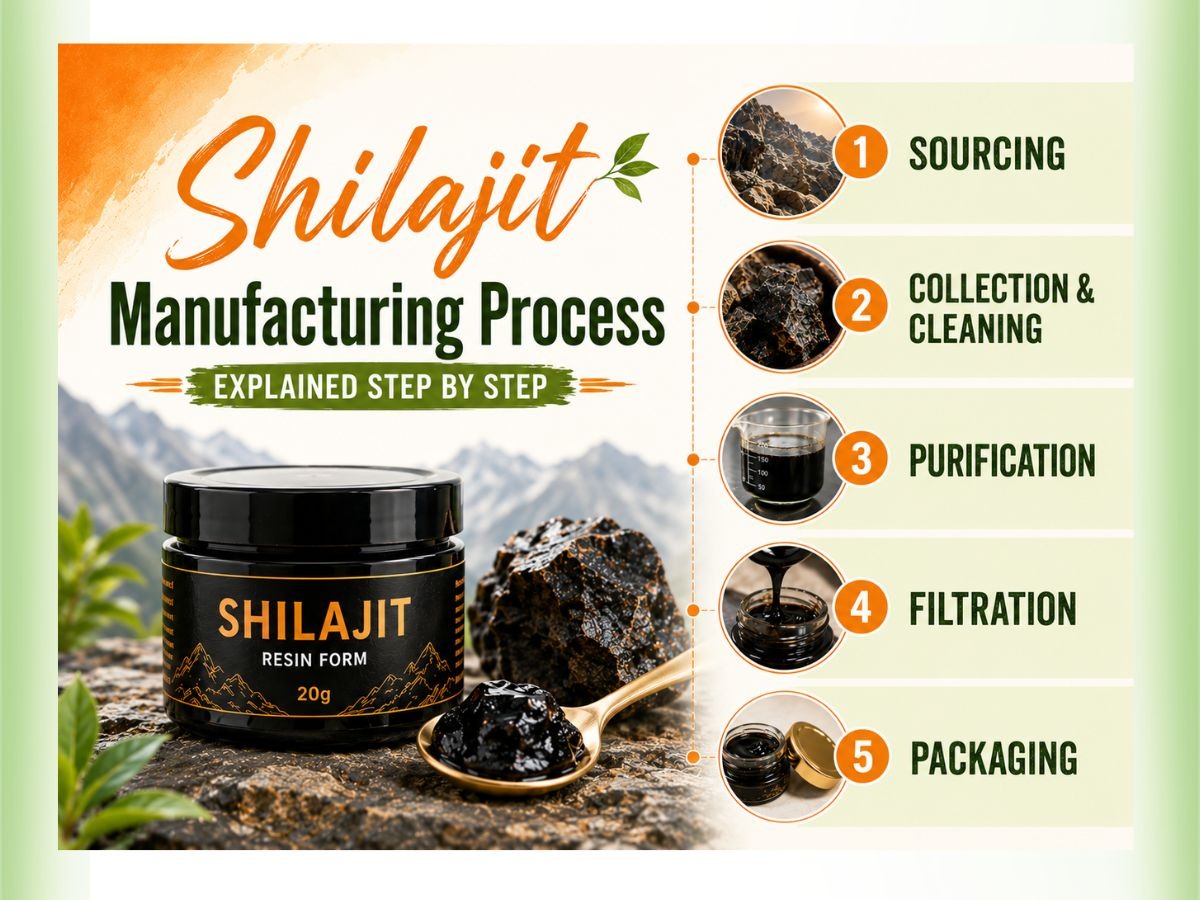
The Shilajit Manufacturing Process consists of several steps from the collection of raw shilajit extracted from the Himalayas up to its purification. Such stages as procurement, Ayurveda purification, filtration, standardization, laboratory testing, and packaging constitute the manufacturing process. The manufacturing process of Sanskar Ayush Shilajit will be analyzed in the following article.
What is Shilajit?
Shilajit is a natural product whose composition is rich with various minerals and which is collected mostly in the Himalayas. The composition of shilajit takes hundreds of years to form and consists in the decay of medicinal plants’ composition and other substances under the pressure of mountainside rocks. The nutrient-rich substance oozes from the rocks during hot weather and gets collected.
In terms of Ayurvedic medicine, the composition of shilajit is considered extremely potent and constitutes such substances as fulvic acid, humic compounds, minerals, and other substances, thus making shilajit one of the most precious substances in Ayurvedic medicine.
As for pure shilajit, however, it cannot be consumed by people directly. There should be numerous stages of its manufacturing first.
Complete Shilajit Manufacturing Process Step by Step
Step 1: Sourcing Raw Shilajit from Himalayan Regions
The first step in the process of Shilajit manufacturing involves the sourcing of genuine raw Shilajit from Himalayan areas.
Considerations during Sourcing
- Genuine sourcing locations
- Authentication of the raw material suppliers
- Harvesting techniques
- Sustainable methods of collection
- Pre-collection material assessment
The quality of the final product is largely dependent on the quality of the raw materials that are sourced here.
- Why Sourcing is Important
- Negligent sourcing may lead to:
- Low levels of purity
- Less active ingredients
- Greater chances of contamination
- Unreliable quality of the end product
This explains why serious manufacturers invest heavily in sourcing their raw materials.
Step 2: Raw Material Inspection and Authentication
Once acquired, the raw Shilajit is carefully inspected.
Inspection Criteria
✔ Appearance
✔ Consistency
✔ Color
✔ Fragrance
✔ Moisture Level
✔ Contaminants Presence
Each batch goes through careful evaluation before moving to the production stage. Any material not meeting the internal quality standards is discarded.
Step 3: Cleaning and Pre-Processing
Impurities found in Raw Shilajit include the following:
- Particles of sand
- Stones
- Dust
- Plant matter
- Contaminants from the environment
These are removed from the material prior to extraction through cleaning processes.
Purpose of Cleaning
- Increase efficiency of extraction
- Minimize contamination
- Improve the quality of the product
- Facilitate further processing of the product
This forms the basis of manufacturing a superior product.
Step 4: Water Extraction Process
Once cleaned, the Shilajit is transferred into extraction vessels.
Purified water is added, and controlled agitation helps dissolve beneficial compounds.
Extraction Process Flow
Raw Shilajit Collection
↓
Inspection & Authentication
↓
Cleaning & Screening
↓
Water Extraction
↓
Filtration
↓
Purification
↓
Concentration
↓
Testing
↓
Packaging
Benefits of Extraction
- Separates soluble compounds
- Removes insoluble matter
- Enhances purification efficiency
- Improves consistency
This process helps isolate valuable constituents from unwanted materials.
Step 5: Multi-Stage Filtration
The liquid obtained will go through several filtration steps to increase purity.
Steps for Filtration:
- Removing rock pieces
- Removing sand pieces
- Removing plant material
- Removing fine impurities
Filtration is important because it assists in:
- Improving clarity of the product
- Increasing purity
- Increasing safety
- Assisting standardization
Multi-level filtration is one of the key quality control steps in Shilajit processing.
Step 6: Ayurvedic Purification (Shodhana)
The process of purification,called Shodhana in Ayurveda, is among the most crucial steps in the process of manufacturing Shilajit.
The raw form of Shilajit might have impurities which need to be removed before any human use.
Purpose of Shodhana
- Increasing purity
- Making it safe
- Removing undesired components
- Preparing the product for further standardization
- Reasons for Conducting the Process
The absence of purification means that there will be contaminants in the raw form of Shilajit.
Step 7: Controlled Concentration Process
After extraction, the liquid extract is subjected to concentration.
What Takes Place in Concentration?
- Excess water is eliminated
- Active ingredients are concentrated
- Consistency is improved
- Increased stability
Manufacturing Quality Control Measures
During this step, manufacturers control:
- Temperature
- Duration of processing
- Concentration of the extract
- Consistency of batches
Step 8: Standardization of Active Components
Standardization plays a crucial role in Modern Shilajit Production.
- Parameters Assessed
- Fulvic Acid Percentage
- Mineral Composition
- Water Content
- Ash Content
- Extraction Efficiency
Importance of Standardization
Standardization guarantees:
✓ High Quality
✓ Strong Potency
✓ Consistency in Batches
✓ Increased Customer Trust
It is an important step in creating high-end Shilajit products.
Step 9: Laboratory Testing and Quality Control
In Sanskar Ayush, quality assurance forms part of all stages of production processes.
Tests Conducted For Quality Assurance
Heavy Metals Tests
Measures the amount of:
- Lead
- Mercury
- Arsenic
- Cadmium
Microbial Tests
Detects:
- Bacteria harmful to health
- Yeast
- Molds
- Identity Tests
Ensures identification of raw materials.
Stability Tests
Check the shelf life of products.
Purity Test
Ensures adherence to company quality standards.
Step 10: Product Conversion and Manufacturing
The approved pure extract is then prepared in various forms of products.
Common Forms of Shilajit Products
Shilajit Resin
Traditional semi-liquid form.
Shilajit Capsules
Easy consumption form.
Shilajit Tablets
Standard dosage form.
Shilajit Powder
Ideal for making custom formulas.
Custom Formulas
Made based on brand needs.
Step 11: Packaging Process
Product quality is maintained by using appropriate packages.
Objectives of Product Packaging
- To prevent moisture contamination
- To maintain stability
- To preserve the product
- To enhance shelf life
Types of Packages
- Glass Bottles
- HDPE Containers
- Blister Packages
- Pouches
- Private Label Packaging
Step 12: Storage and Distribution
Finished products are stored under controlled conditions before distribution.
Storage Requirements
- Controlled temperature
- Low humidity
- Protection from direct sunlight
- Batch traceability systems
Proper storage helps preserve product quality throughout its shelf life.
Raw Shilajit vs Purified Shilajit
| Parameter | Raw Shilajit | Purified Shilajit |
| Purity | Variable | Standardized |
| Safety | Lower | Higher |
| Contaminants | Possible | Controlled |
| Testing | Limited | Comprehensive |
| Consumer Ready | No | Yes |
Purified Shilajit is always preferred for consumer use due to its improved safety and quality profile.
Shilajit Resin vs Shilajit Capsules
| Feature | Resin | Capsules |
| Traditional Usage | Yes | No |
| Convenience | Moderate | High |
| Portability | Moderate | Excellent |
| Dose Accuracy | User Controlled | Standardized |
| Ease of Use | Moderate | High |
Both forms can be manufactured using standardized Shilajit extract.
Expert Insight from Sanskar Ayush
Quality of shilajit is not only determined by the source but also by its manufacturing, purification, and standardization process. A proper manufacturing process ensures that the shilajit is consistent and pure.
At Sanskar Ayush, each batch goes through various quality check points from the point of procuring raw materials until packaging.
Why Choose Sanskar Ayush for Shilajit Manufacturing?
The Sanskar Ayush Medicare Pvt. Ltd. promises to deliver high-end ayurvedic and herbal products by following modern manufacturing techniques and high standards of quality control.
Strengths of Our Manufacturing Division
✔ State-of-the-Art Manufacturing Units in Compliance With GMP Standards
✔ Qualified Ayurvedic Experts
✔ Robust Quality Control Procedures
✔ Private Labeling
✔ Special Product Formulations
✔ Batch-Wise Quality Control
Conclusion
The Shilajit Manufacturing Process consists of much more than simply obtaining raw material from the mountains. This is a process of scientific precision and high quality which encompasses sourcing, processing, extraction, filtration, Ayurvedic purification, concentration, standardization, laboratory testing, packaging, and distribution.
Sourcing, processing, extraction, filtration, Ayurvedic purification, concentration, and standardization of the final product by Sanskar Ayush ensure the production of high-quality Shilajit products. With the blending of Ayurveda and modern manufacturing processes, we aim at producing high-quality products for our consumers and the brand you choose.
Want to get high-quality products manufactured from the finest Shilajit? We offer Ayurvedic product manufacturing services including third-party manufacturing and private labeling
Frequently Asked Questions
We have a Professional and Experienced Team who always bring Innovative Ideas.
How is Shilajit manufactured?
Shilajit is manufactured through sourcing, cleaning, extraction, filtration, purification, concentration, standardization, testing, and packaging.
What’s the role of Shodhana in the Shilajit factory?
Shodhana is an Ayurvedic purification process that removes impurities and helps improve product quality.
Why is purification important in the Shilajit Manufacturing Process?
Purification removes unwanted materials and improves product safety, consistency, and quality. Fulvic acid is one of the key natural compounds in Shilajit.
How is Shilajit tested?
Manufacturers test Shilajit for heavy metals, microorganisms, stability, purity, and identity verification.
What is the difference between Shilajit resin and capsules?
Shilajit resin is the traditional form, while capsules provide convenience and consistent dosage.