Asav and Arishta (आसव और अरिष्ट ) are really popular in Ayurveda because they can give us the benefits of herbs in a way that our bodies can use easily. They are made using a process where the ingredients are allowed to ferment. People have been using Asav and Arishta for a long time to help with digestion and to keep their immune system strong. They also help with metabolism and overall health.
Although Asav and Arishta are often grouped together, they are not the same.The way Asav is made is not the same as the way Arishta is made. The ingredients used in Asav are not the same as the ingredients used in Arishta. Even the health problems that Asav and Arishta are used to treating are not the same. Knowing the differences between Asav and Arishta can help people choose the one for their specific health needs.
What is Asav and Arishta in Ayurveda?
Asav and Arishta are traditional Ayurvedic fermented preparations called Sandhana Kalpana. The resulting formulas contain herbs and natural sweetening agents, and a process fermentation that generates self-sourced alcohol in a controlled way. This organic fermentation aids in the extraction of the active ingredients, promotes bioavailability, and can also preserve the formulation free from artificial preservatives.
Asav and Arishta have been used for millennia in Ayurveda to facilitate digestion, metabolism, immunity, respiratory health, female health, and body wellness.
Asav and Arishta — The Difference in The Key
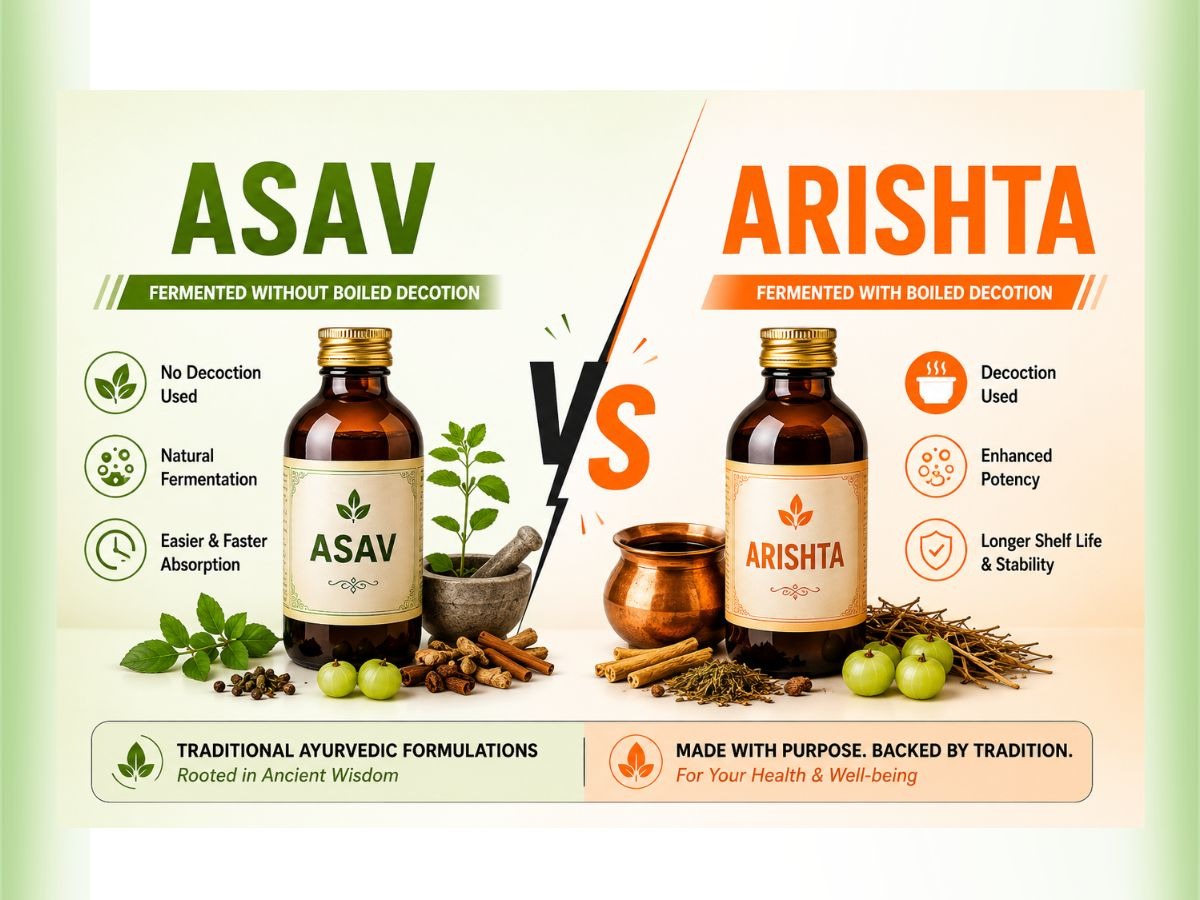
The main difference is the processing of the herbal ingredients prior to fermentation.
- Asav (Asava) is made with fresh herbal juice or cold infusion without a boil.
- Arishta is fermented and boiled.
The difference between the extraction of active compounds in the dried product and the medicinal potential of the finished product affects the preparation of the finished medicinal product.
Difference Between Asav and Arishta as per Ayurveda
Feature | Asav (Asava) | Arishta |
Preparation Method | Made from fresh herbal juice or cold infusion | From herbal decoction |
Use of Heat | No boiling involved | Herbs are boiled before fermentation |
Fermentation process | Direct fermentation | Fermentation after decoction preparation |
Active Compound Retention | Preserves heat-sensitive compounds | Extracts heat-stable compounds effectively |
Taste Profile | Usually lighter and milder | Frequently more concentrated and stronger |
Classical Function | Quick absorption and preservation of delicate ingredients | Deeper extraction of medicinal compounds |
Examples | Kumaryasava, Lohasava, Arvindasava | Ashokarishta, Dashmoolarishta, Draksharishta |
How Are Asav and Arishta Prepared?
Preparation of Asav
Preparation usually consists of:
- Collection of fresh herbs or herbal juices
- Composition of jaggery, sugar, and honey as sweetening agents
- Addition of fermentation-supporting ingredients
- Fermentation is done naturally in sealed containers
- Filtration and maturation
Since no boiling takes place heat-sensitive phytochemicals remain highly stable.
Preparation of Arishta
The actual preparation is, if needed, as follows:
- Preparation of herbal decoction through boiling
- Filtration of the decoction
- Incorporation of jaggery, sugar or other fermentation agents
- Controlled fermentation
- Maturation and filtration
This promotes the extraction of medicinal compounds in greater depth because they are heat-dependent for proper release.
Why Fermentation Is Important in Ayurveda?
One of the greatest marvels of Asav and Arishta in Ayurveda is the natural fermentation process.
Fermentation helps:
- Enhancing the bioavailability of herbs products
- Improve absorption from the body
- Increase shelf life
- Support digestive fire (Agni)
- Preserve the active ingredients from nature
Fermented formulas have been considered effective (and stable) for centuries in classical Ayurvedic texts.
Popular Examples of Asav
Asav is used in the following formulations:
Kumaryasava
Originally used to nourish the gastrointestinal tracts and assist the liver.
Lohasava
Commonly found in Ayurvedic formulations which are supplemented with iron based ingredients.
Arvindasava
Prominent in pediatric wellness support.
Kanakasava
Commonly consumed in respiratory wellness formulations.
Popular Examples of Arishta
Ashokarishta
One of the most familiar Ayurvedic formulations for women’s health.
Dashmoolarishta
Used traditionally to aid the recovery process, improve power and health/vitalization, and general wellness.
Draksharishta
Made from grapes, with an emphasis on digestion and rejuvenation.
Saraswatarishta
Long linked to cognitive health and mental clarity.
Expert Insight: The Importance of Quality Manufacturing
The performance of Asav and Arishta is not dependent on its classic formulations alone but on the quality of manufacturing methods as well.
Using industry knowledge, the major factors influencing products’ quality include:
- Selection of authentic herbs
- Controlled fermentation conditions
- Quality testing protocols
- Hygienic manufacturing environments
- Compliance with Ayurvedic principles
- Proper maturation periods
The best classical formulation in the world may not work as well as expected if manufacturing standards are violated.
How Sanskar Ayush Produces Quality Ayurvedic Formulations
Being the reputable Ayurvedic manufacturing company that produces classical ayurvedic formulations, for example Asav & Arishta, through manufacturing processes that are GMP compliant. The high level of quality control, the herbal authenticity, and the regulatory compliance are highly regarded by the company, which has contemporary production facilities. Ayurvedic medicines, herbal products, and traditional formulations formulated according to Ayurvedic principles are in its portfolio.
Such dedication to quality guarantees the continuity of efficacy, safety, and consistency throughout Ayurvedic formulations.
The advantages of Asav and Arishta in Ayurveda
The main benefits include:
- Enhanced absorption
- Natural preservation
- Improved shelf life
- Better bioavailability
- Traditional Ayurvedic authenticity
- Convenient liquid dosage form
This is what makes fermented formulations of Ayurvedic medicine such an important component for classical Ayurvedic treatment, because of these characteristics.
Conclusion
Differentiating between Asav and Arishta within Ayurveda will benefit everyone who is interested in Ayurveda medicine, herbal health or traditional formulation. Although both are fermented preparations that have enormous therapeutic potential their methods of preparation, and their methods of processing ingredients and applications, differ dramatically.
Aided by combining ancient Ayurvedic knowledge with modern quality manufacturing techniques, renowned manufacturers such as Sanskar Ayush are able to maintain the validity and effectiveness of these centuries-old products to meet modern healthcare needs through a combination of classical Ayurvedic wisdom of traditional and contemporary production techniques.
FAQs
Asav consists of fresh herbs, juices or cold infusions, with boiling avoided, whereas Arishta consists of decoctions, which are boiled before fermentation.
Yes. They contain low amounts of self-generated alcohol resulting naturally from fermentation, which retains the composition and increases the concentration of bioactive components.
Neither Asav nor Arishta is inherently stronger than the other. Their effectiveness depends on their ingredients, formulation, and the specific health condition being treated.
Fermented formulations are important in Ayurveda because the natural fermentation process enhances the absorption and effectiveness of herbal ingredients. These formulations are believed to have better bioavailability, a longer shelf life, and faster therapeutic action compared to many non-fermented preparations. As a result, they are widely used to support various health conditions and improve overall treatment outcomes.
Some common examples of Asav include Kumaryasava and Lohasava. Popular examples of Arishta include Ashokarishta, Dashmoolarishta, and Draksharishta. Each formulation is prepared using specific herbs and is prescribed for different health conditions in Ayurvedic practice.